
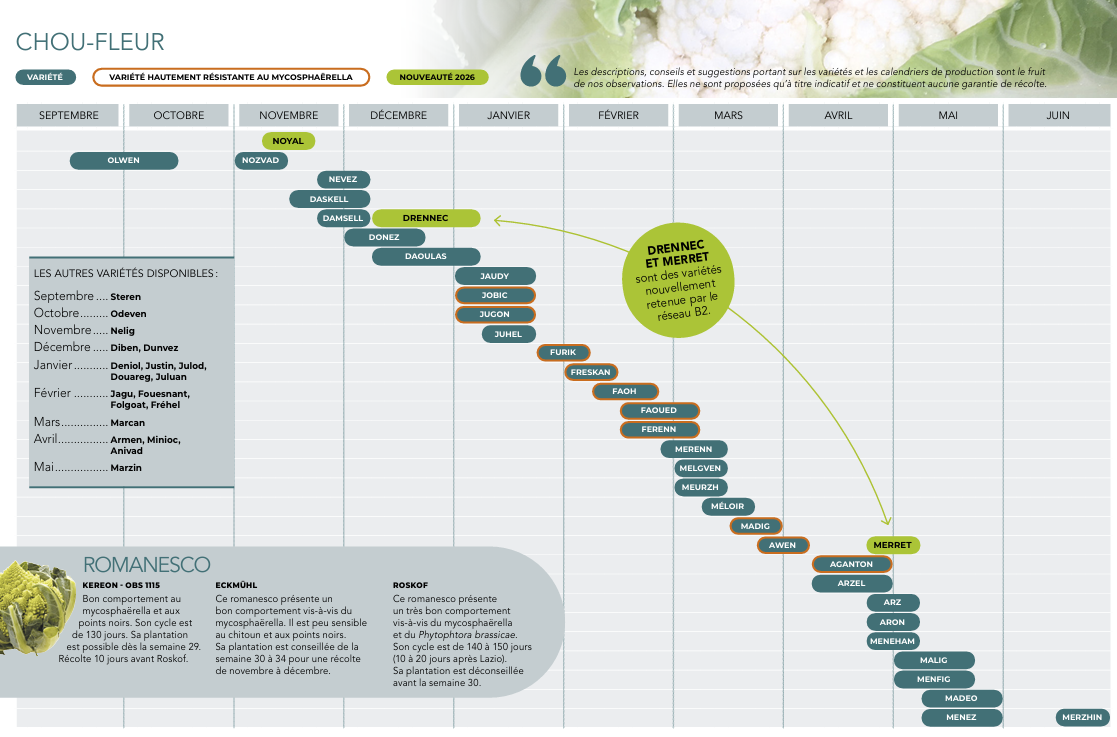
OBS offers you a range of cauliflower varieties to cover a wide production calendar.


A vigorous variety with very good coverage. Fungicide protection is necessary. Its cycle is 95 to 115 days, just before Daskell. This hybrid is flexible on planting dates.
Same production slot as Daoulas, to which it resembles, but being more rustic and especially with a better root system. Variety selected by the B2 network with an average of 6.3.
Merret is a newly selected cabbage on the B2 network in the Menfig niche. It is a medium size, easy to see and trim with a white head.

A cycle of around 130 days, i.e. a harvest 10 days ahead of schedule. ROSKOF
Short-cycle variety, 85 to 90 days. Can be planted in mini plugs from March. Dense white apple. Not very susceptible to rosetting.
Twelve years ago, the profession asked us to select short-cycle varieties. This cauliflower, which is in the Spacestar and Cortès niche, has the advantage of being able to be planted as early as February for a summer harvest. Its main assets are its very white head, which is not very sensitive to pinking, and its attractive tendril cover.
On October. - ???
Very good coverage with a very white apple. Easy to pack. November slot, 115-day cycle.
A vigorous variety with very good coverage. Fungicide protection is necessary. Its cycle is 95 to 115 days, just before Daskell. This hybrid is flexible on planting dates.
On November. - ???
Close to Damsell (1 cut before). Greater homogeneity and coverage.
White, round and dense apple, easy to find. Easy to pack. Can be planted in mini plugs from mid to late July.
A vigorous variety with good coverage. Fungicide protection is required. Its cycle is 110 to 115 days (one week after Daskell).
Foliage highly resistant to mycosphaërella, vigorous. Very white apple. Susceptible to tip burn. Early December window.
Very white, dense apple. High foliage. Easy to cut. December window. 130-day cycle.
In December, this variety has been tested on a large scale for 2 years. Network growers find it interesting for its winter-like foliage, flexibility, crown and apple quality.
Same production slot as Daoulas, to which it resembles, but being more rustic and especially with a better root system. Variety selected by the B2 network with an average of 6.3.
Production window in December.
Same earliness as Douareg. Its main advantage is that its apples are well-shaped and dense.
With its stocky size and hardy foliage, it stands up well to gales. Same production niche as Jaudy.
Jugon is a cabbage with a root system that tolerates excess water. It is an upright plant requiring good earthing-up.
Crown quality superior to that of Douareg. Good conditioning properties. January window (same as Douareg).
A very well-covered variety with foliage resistant to mycosphaërella. Its production niche lies between Jaudy and Faoh.
Rigorous variety. Light crown foliage. Round, well-covered apple. Niche from mid-December to mid-January.
On January. - ???
Late December - early January. Good vigour, easy to pack.
On January. - ???
On a Douareg niche, good quality foliage. No chitoun problems.
February niche. Healthy foliage with high tolerance to mycosphaërella and high tolerance to xanthomonas. Susceptible to tip burn.
It has just been included in the varieties selected for the B2 network, with an average score of 6.7. Its foliage is healthy and the plant resembles Faoh. Its production window is one week after Furik.
In a mid-February production window.
In February. Foliage highly resistant to mycosphaërella, upright growth habit. Very white apple.
February slot. Between Fréhel and Marcan. Hardy foliage, due to its resistance to mycosphaërella. Dense white apple.
Late February. Its main assets are its very white, dense apples with bluish foliage.
Flowering from late February to early March. Hardy, dark foliage with a tendril for good coverage. Easy to cut.
March niche. Very strong vigour. Well-covered white apple. Highly resistant to mycosphaërella.
A successor to Marcan, it is a variety appreciated in networks for its coverage.
A small cabbage with a production niche between Marcan and Madig. It has just joined the varieties selected by the B2 network with an average of 6.8.
In a mid-March niche. Easy to cut, uniform, dense head. Moderately susceptible to mycosphaërella.
In a mid to late March niche, this variety arrives in the cutting just after Marcan. Highly resistant to Mycosphaerella.
In April, this variety is highly resistant to mycosphaërella. Easy to pack.
Flowering from mid-April. Foliage highly resistant to mycosphaërella, vigorous. Very white apple.
Opens in mid-April. Healthy, upright foliage, highly resistant to mycosphaërella. Easy to pack.
April niche. Vigorous, uniform variety with dense, white apples. Not very susceptible to mycosphaërella.
Mid-April window. A variety with low susceptibility to mycosphaërella, characterised by its white apples and good coverage.
Merret is a newly selected cabbage on the B2 network in the Menfig niche. It is a medium size, easy to see and trim with a white head.
A medium-sized plant, with a size that is easy to assess, which was selected by the B2 network with an average of 6.7.
Harvested between Arcouest and Maëlig. This is a vigorous, uniform variety with heavy, well-covered apples. It has low susceptibility to mycosphaërella but is not highly resistant.
It has also just been included in the varieties selected by the B2 network. Its 3-year average is 6.8. Its production niche is between Aron and Madeo. It is a vigorous plant with good coverage and is quick to cut.
In a May slot. - ???
In a Maë niche, this variety was described by growers as being more uniform, better covered and less sensitive to loosening.
In order to strengthen this niche. This variety is cut on average one week after Maë. Its growth rate is not too fast, so it can be cut at longer intervals.
Niche from early to mid-May. Very well covered. Dense. Very clustered.
15 days after Maëlig. This variety has the advantage of being able to produce quality late cauliflower when grown in mini clusters.
This variety has the longest cycle in our range. Starts 5 to 8 days after Menez.
Good resistance to Mycosphaerella and black spot. Its cycle is 130 days. Planting is possible from week 29. Harvest 10 days earlier ROSKOF.
This romanesco shows good resistance to *Mycosphaerella*. It is not very susceptible to downy mildew and black spot. Planting is recommended from week 30 to 34 for harvest between November and December.
This romanesco performs very well against Mycosphaerella and Phytophtora brassicae. Its cycle is 140 to 150 days (10 to 20 days after Lazio). It should not be planted before week 30.


 English (UK)
 Français
 Italiano